Course
CARSI Professional Moisture Meters: Readings, Corrections and Dry Standards
Moisture meters for Australian and NZ restoration: pin and pinless meters, oven-dry MC, percent versus points, temperature and species corrections, timber, plasterboard and slabs, calibration checks, dry standards and moisture maps, with worked examples and a 20-question check.
A CARSI course and a CARSI-issued credential. Verify a credential.
Instructor CARSI Catalog
$99
Price
5h
Duration
24/7
Online access
Trusted by cleaning and restoration teams across Australia
About this course
What you will work through
CARSI Professional Moisture Meters: Readings, Corrections and Dry Standards teaches restoration technicians, supervisors, building inspectors and insurance-support staff in Australia and New Zealand to take moisture readings they can defend. It follows CARSI Building Science Foundations and turns meter numbers into statements a loss adjuster, builder or flooring installer can check.
Six modules of short lessons. Every lesson has a job scenario, one idea explained plainly, an illustration and a diagram, a worked example in metric units, a one-page field download and three check questions; every module ends with a module check. The modules cover how resistance (pin) and dielectric (pinless) meters respond to water and what oven-dry moisture content means; percent versus points, reliable ranges, and temperature and species corrections; reading timber framing, plasterboard or concrete slabs and diagnosing false highs; daily calibration checks and the six common meter mistakes; and dry standards, moisture maps and the relining or floor-covering call, finishing with a full case study and a 20-question knowledge check.
Built on open sources: the USDA Wood Handbook (public domain), the Queensland Building and Construction Commission flood rebuilding guide and Construction timbers in Queensland (CC BY 4.0), and New Zealand’s Guide to tolerances (CC BY 3.0). Every claim links to its source. Real meters are named and shown where a lesson teaches that instrument; generic readings stay generic. Paid standards named by edition only. Metric throughout, Australian mains (230 V, 50 Hz) assumed.
Outcomes
What you will take back to site
01
Apply current Australian and New Zealand methods to real-world restoration jobs
02
Build competency in CARSI training, with a CARSI-issued credential
03
Receive a verifiable digital credential for your professional portfolio
Syllabus
How the course is built
6 modules · 38 lessons · 5h
01
Module 1: Start Here — Your Mission, Safety and the Sources
- Your mission: moisture readings you can defendPreview
- Safety first: pins, power and contaminated materials
- The source map: open guides, named standards and what they are for
- Module 1 check
02
Module 2: How Meters Work
- Moisture content and the oven-dry reference
- Resistance (pin) meters: what the pins measure
- Dielectric (pinless) meters: fast scans with a shallow view
- Thermo-hygrometers and thermal imaging: helpers, not moisture meters
- Module 2 reference card: how meters work
- Module 2 check
03
Module 3: Scales and Corrections — What the Number Means
- Quantitative or qualitative: percent versus points
- Reliable ranges: when a high number stops meaning much
- What the room says timber should read: EMC on site
- Module 3 reference card: scales and ranges
- Temperature correction for pin meters
- Species correction: the maker’s table, applied properly
- Why some readings run high
- Module 3 reference card: corrections
- Module 3 check
04
Module 4: Reading Real Materials — Timber, Plasterboard and Concrete
- Timber framing and floors: where and how to read
- Plasterboard: the known-dry patch and the wet boundary
- Concrete slabs: surface readings versus hygrometer tests
- EPS in concrete: are you testing the slab, the screed, or a void?
- False highs and false lows: a field diagnosis routine
- Module 4 reference card: reading real materials
- Module 4 check
05
Module 5: Calibration Checks and the Six Common Mistakes
- Daily calibration checks and what to do when a meter fails
- The six common meter mistakes
- Air readings you can trust: placing and checking a hygrometer
- Module 5 reference card: calibration and mistakes
- Module 5 check
06
Module 6: Baselines, Moisture Maps and the Drying-Complete Decision
- The dry standard and the drying goal
- Moisture maps and the daily log
- Relining and floor coverings: making the call
- Case study: a hallway and laundry leak, start to sign-off
- Field checklist, reference card and next steps
- Module 6 check
- Final knowledge check: mixed practice across all modules
Free lesson
Your mission: moisture readings you can defend
No account needed
Learning objective: by the end of this lesson you will be able to say what makes a moisture reading defensible, what this course assumes you already know, and how it labels quotes, paraphrase and CARSI method. Figures in the worked example are a CARSI illustration, not from a real job.
On the job
A loss adjuster is reviewing a water-damage claim on a brick-veneer house in Ipswich, Queensland. The restorer's job note says only "hallway wall dry". It does not record which meter was used, whether it was in pin or pinless mode, where on the wall the reading was taken, or what a dry wall reads in that house. The adjuster cannot check the call, and the technician cannot defend it. This course closes that gap.
The idea
Welcome to CARSI Professional Moisture Meters: Readings, Corrections and Dry Standards.
Course mission. On a real Australian or New Zealand job you will choose the right meter for each material, take readings in a way you can repeat, correct them where a correction applies, compare them with an unaffected baseline from the same building, and write a drying-status statement that a loss adjuster, builder or second technician can check. Every lesson ends in something you will do with a meter in your hand.
A meter gives you a number. A number alone is not a statement. A defensible reading is one that someone else could repeat: it names the instrument category and its mode, the exact location and depth, any correction applied, and the baseline it is compared with. The diagram below shows that chain from reading to written statement, and the rest of the course teaches each link.
Learning objectives for the whole course
By the end of this course you will be able to:
- calculate moisture content (MC) from wet and oven-dry mass, and explain why that is the reference every meter is trying to estimate;
- explain how a resistance (pin) meter and a dielectric (pinless) meter respond to water, and state one limit of each;
- tell a quantitative (material-calibrated) reading from a qualitative (reference-scale) reading and report each correctly;
- apply a temperature correction and a maker's species correction to a timber reading, showing the arithmetic;
- read timber, plasterboard or concrete with the right technique and spot the common causes of false high readings;
- run a daily calibration check and avoid the six common meter mistakes;
- set a dry standard from unaffected material, keep a moisture map, and justify a drying-complete or relining decision in numbers.
How the course is laid out
There are six modules. Module 1 (this one) covers your mission, safety and the sources. Module 2 covers how meters work. Module 3 covers scales and corrections, meaning what the number means. Module 4 covers reading real materials. Module 5 covers calibration checks and the six common mistakes. Module 6 covers baselines, moisture maps and the drying-complete decision, and ends with a final knowledge check.
Where this course sits
This course comes directly after CARSI Building Science Foundations: Psychrometry, Moisture and Condensation, which teaches dew point, humidity ratio (g/kg) and equilibrium moisture content (EMC); this course assumes you can calculate those. It is a recommended step on the pathways to the CARSI Southern Hemisphere Restoration Designations. Where a lesson teaches a particular kind of instrument, it names and shows real meters; readings and methods any instrument does stay generic. Buy any meter from an Australian supplier and confirm its battery type, charger (230 V, 50 Hz) and calibration documents at purchase.
How to read the sources in this course
- Quote: words inside a quote block with a "Quote:" line are copied word for word from an openly licensed source, with its title, publisher, year, section and link.
- Paraphrase: a sentence that ends with a linked source in brackets is CARSI's own wording of what that source says.
- CARSI method / CARSI worked example: sections with these labels are CARSI's own field method and arithmetic. Every number in a worked example can be checked with the formula next to it.
Paid standards (Australian and New Zealand Standards, ASTM and IICRC documents) are named by number and edition only. Where one matters, the lesson tells you to check its current edition yourself. The free, plain-English reference this course builds on is the USDA Forest Products Laboratory's Wood Handbook, chapter 13 (Bergman, 2010, public domain), whose abstract says the chapter is "concerned with moisture content determination".
See it

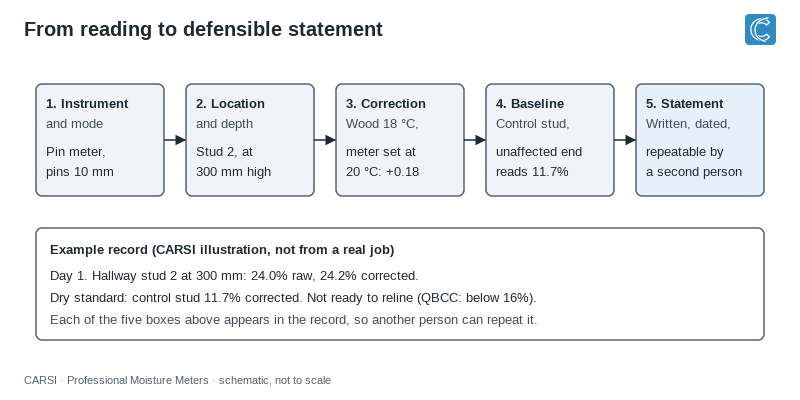
The illustration shows the habit this course builds: reading and recording at the same time. The diagram shows what the record must contain.
Do it in metric
Compare two ways of writing the same hallway reading. All numbers are a CARSI illustration; the method for the correction is taught in Module 3.
- Indefensible note: "Hallway wall dry." Nothing in it can be checked.
- Instrument and mode: resistance (pin) meter, pins 10 mm into the stud.
- Location and depth: stud 2, read at 300 mm above the slab.
- Raw reading and conditions: 24.0% with the wood at 18 °C and the meter calibrated at 20 °C.
- Correction: +0.18, so 24.0% becomes 24.2%.
- Baseline: control stud in the unaffected end of the hallway, 11.5% raw, 11.7% corrected.
- Statement: "Day 1. Stud 2 at 300 mm: 24.2% against a dry standard of 11.7%. Not ready to reline (QBCC: framing below 16%)."
The second version takes about a minute longer to write and can be repeated by anyone with the same meter.
Try it
Your note says "stud 4 read 17%". Which four things must you add before another person can check it?
Check your answer
The instrument category and mode (for example pins 10 mm), the location and height (for example 300 mm above the slab), any correction applied with the wood temperature, and the unaffected baseline it is compared with.
Field download
The Before-you-read safety and source card (one page) (attached to this lesson) has a "defensible reading" record line you can copy onto your job note. Use it every time you write a reading down.
Check yourself
The Module 1 check asks three questions on this lesson: what makes a reading defensible, what the course assumes you already know from Psychrometry, and how the course labels its own method. Each answer explains why.
- Name the four details a defensible reading records beyond the number.
Answer
Instrument and mode, location and depth, any correction applied, and the baseline it is compared with.
- Which earlier course does this one assume you have done?
Answer
CARSI Building Science Foundations: Psychrometry, Moisture and Condensation, for dew point, g/kg and EMC.
Takeaway
A meter gives you a number. This course teaches you to turn that number into a statement you can defend. Next: Safety first: pins, power and contaminated materials.
Sources for this lesson
- Bergman (2010), Wood Handbook chapter 13, USDA Forest Products Laboratory FPL-GTR-190 (public domain). Read 20/11/2026.
- Queensland Building and Construction Commission, A contractor's guide to rebuilding after a flood (May 2020), CC BY 4.0, p. 4. Read 20/11/2026.
Stuck on any step? Ask your CARSI trainer in the course discussion before you move on.
Who it is for
Built for crews who cannot leave site
- Restoration and cleaning industry professionals
- Trade professionals expanding their qualifications
- Business owners investing in team development
Enrol
Start this course when the roster allows
Complete the course and receive a verifiable digital credential for your portfolio.
References
Sources this course cites
Gathered from the source list at the end of each lesson. Standards are named by number and edition only.
- Bergman (2010), Wood Handbook chapter 13, USDA Forest Products Laboratory FPL-GTR-190 (public domain) (opens in a new tab)Read 20/11/2026
- Queensland Building and Construction Commission, A contractor's guide to rebuilding after a flood (May 2020), CC BY 4.0, p. 4 (opens in a new tab)Read 20/11/2026
- Safe Work Australia, Electrical safety: WHS duties (opens in a new tab)Read 20/11/2026
- Safe Work Australia, Model Code of Practice: Managing electrical risks in the workplace (2018) (opens in a new tab)Read 20/11/2026
- Australian Resilient Flooring Association, Technical Bulletin 001, Moisture testing of concrete subfloors (April 2025), Testing Depths (opens in a new tab)Read 20/11/2026
- Construction timbers in Queensland, Book 1: Definitions (January 2020), CC BY 4.0, definitions list (opens in a new tab)Read 20/11/2026
- New Zealand Building Code (Building Regulations 1992, Schedule 1), clauses E2 and E3 (opens in a new tab)Read 20/11/2026
- Ministry of Business, Innovation and Employment (NZ), Guide to tolerances, materials and workmanship in new residential construction (2015), CC BY 3.0, section 2.5 Timber floor boards (opens in a new tab)Read 20/11/2026
- Standards Australia store listing, AS/NZS 1080.1:2012, shown as Current (opens in a new tab)Read 20/11/2026
- Standards Australia store listing, AS 1884:2021, shown as Current (opens in a new tab)Read 20/11/2026
- ASTM International store, F2170 (F2170-19a listed) (opens in a new tab)Read 20/11/2026
- Wood Handbook ch. 4, Thermal, Electrical, and Other Properties, USDA Forest Products Laboratory FPL-GTR-190 (public domain) (opens in a new tab)Read 20/11/2026
- RICS Built Environment Journal, An introduction to building thermography (17 November 2020), professional body source (opens in a new tab)Read 20/11/2026
- IRISS, Moisture intrusion detection with infrared thermography (industry source) (opens in a new tab)Read 20/11/2026
- State of Queensland, Construction timbers in Queensland, Book 2: Specifications (January 2020), Schedule B, CC BY 4.0 (opens in a new tab)Read 20/11/2026
- Standards Australia store preview, AS 1884:2021, normative references (opens in a new tab)Read 20/11/2026
- AS 1884:2021 and ASTM F2170-19a are named by number and edition; only their public store listings were read, and no standard text is reproduced.
- ARDEX Australia, TB018 Lightweight Bulk Fill Systems (2 October 2024) (opens in a new tab)Read 20/11/2026
- Hunter Pods, How to install (opens in a new tab)Read 20/11/2026
- ASTM International, F2659-23 scope, store page (opens in a new tab)Read 20/11/2026
- Wagner Meters, 10 Guidelines for ASTM F2170 Concrete Testing and Preparation (opens in a new tab)Read 20/11/2026
- SafeWork NSW, Working safely when cutting, drilling and grinding concrete and masonry products (code of practice, commenced 22 May 2026) (opens in a new tab)Read 20/11/2026
- WorkSafe Victoria, Safe concrete cutting and drilling (edition 3) (opens in a new tab)Read 20/11/2026
- WorkSafe Queensland, Handheld and stand-mounted drills (last updated 28 April 2023) (opens in a new tab)Read 20/11/2026
- Delmhorst, What to avoid when testing moisture in your flooring system (meter maker guidance) (opens in a new tab)Read 20/11/2026
- Delmhorst, Take care of your moisture meter (meter maker guidance on cleaning the pins) (opens in a new tab)Read 20/11/2026